Contents
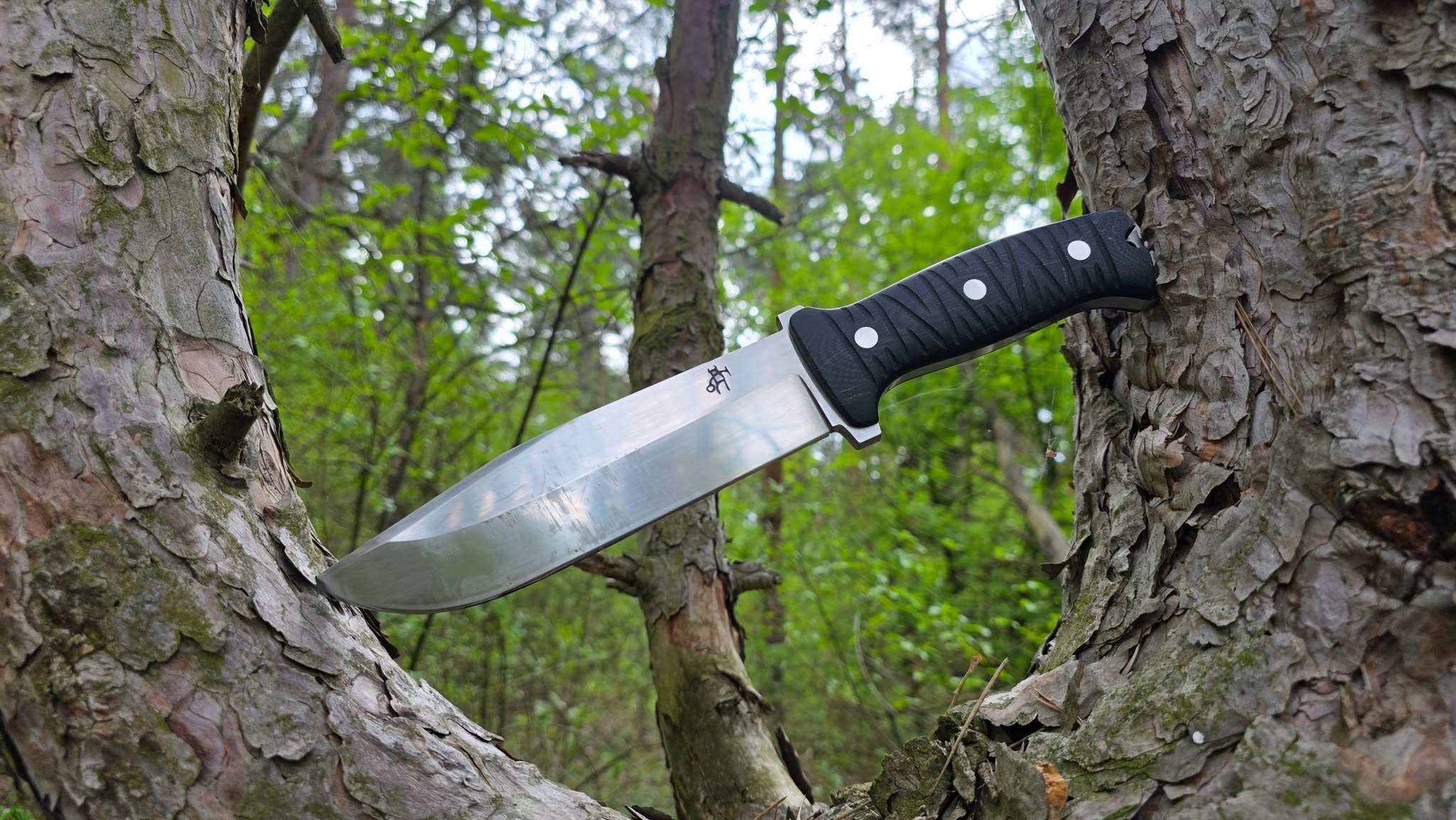
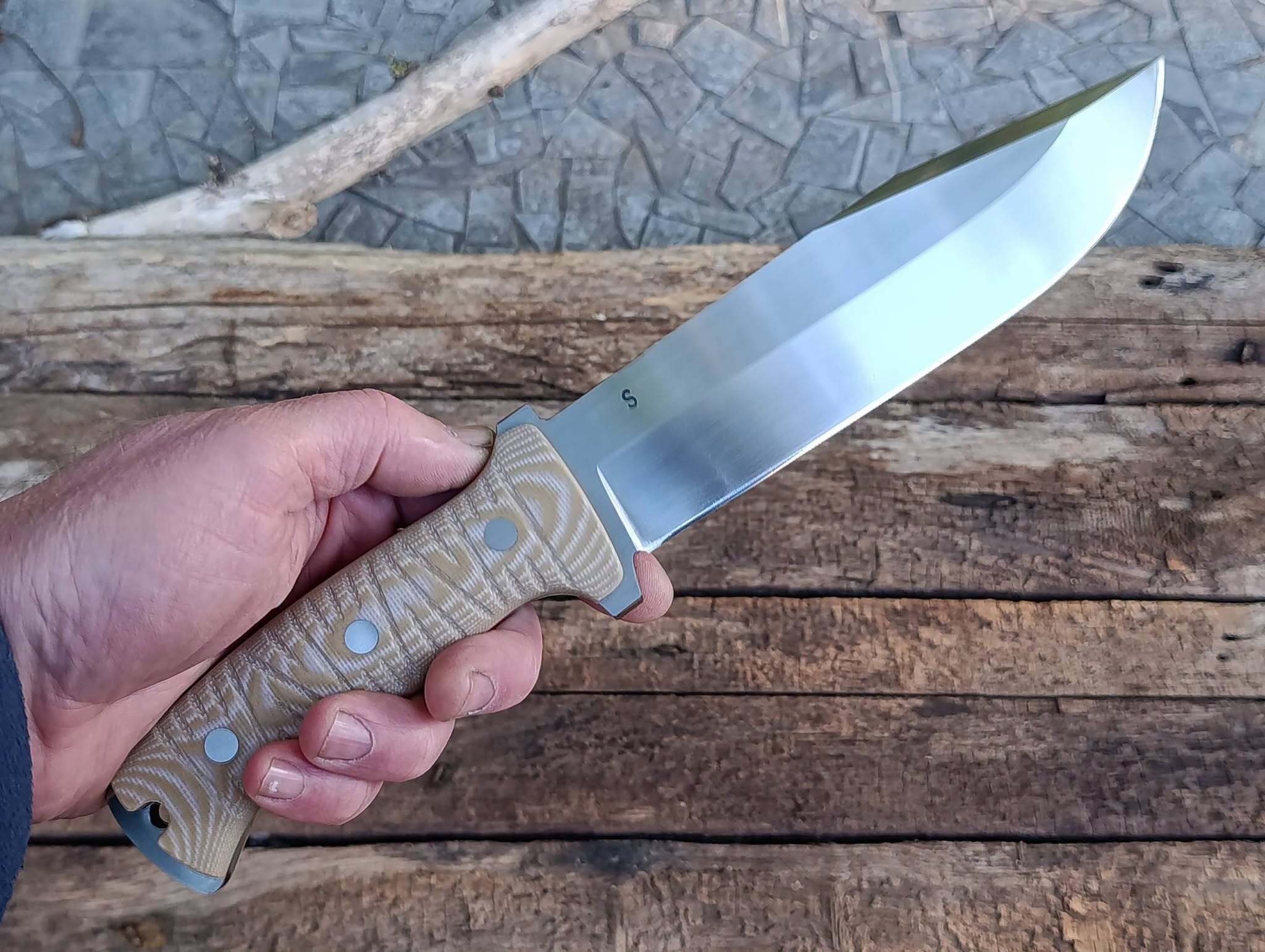
Who didn’t want a Bowie knife as a child or teenager?! There it was in the hands of our heroes on the telly and on the big screen. I, too, dreamt of owning a knife like that one day. Then, as an adult, I made my own. It’s such a massive blade that when you put it down on the table, everyone looks at it. The blade is 18 centimetres long, and the spine is 8 millimetres thick. Pick it up, and you’ll immediately understand why I made it this size. I made it to last a lifetime. Then your children can decide which one of them gets it. A genuine Shaman knife.
In Jim Bowie’s day, it looked quite different
If I had to sketch a Bowie knife from memory, I’d start with the long blade. I’d taper the spine just before the point, and draw the crossguard in front of the handle. However, the knife that started it all, according to accounts, looked more like a large butcher’s knife.
It is September 1827, on a sandbar on the Mississippi, near Natchez. Two men had a duel, after which a brawl broke out amongst those present. It was through this incident that Jim Bowie and his large knife entered the public consciousness. There are several accounts of exactly who made the first knife. Jim’s elder brother, Rezin, claimed credit for the design. The name of James Black from Arkansas crops up in connection with a later knife made for Jim. Texas State Historical Association · Historic Arkansas Museum
The design soon took on a life of its own. Knife makers in Sheffield, England, were already producing Bowie knives for the American market as early as the 19th century. A contemporary Sheffield piece already displays the lines we still look for in a Bowie knife today. As a knife-maker, this is what captivates me about it. Even the early workshops adapted it to their own tastes, and even after two centuries, there is still room for a fresh interpretation. Smithsonian Institution

Nine names that have continued the story of the Bowie
A hunting knife, a Hollywood prop and a large camp knife might seem worlds apart at first glance. Over the past hundred years, all three have helped to keep the Bowie design alive.
Buck 119 Special – a Bowie-style hunting knife
Buck traces the origins of the 119 Special back to the Second World War, and the knife later became one of the best-known models in the brand’s classic 100 series. It features a black handle, a polished crossguard and a deeply notched spine. What I like about the 119 is how recognisable this design remains, even on a much smaller hunting knife. Buck Knives

KA-BAR – from the 1217 to the Becker BK9
The history of KA-BAR’s best-known fixed-blade knife dates back to 1942. The leather-ringed handle and clip-point blade of today’s 1217 USMC model will be familiar to many. Another model provides a more direct illustration of the brand’s Bowie line. KA-BAR even catalogues the Becker BK9 as a Bowie by name. When placed side by side, the difference between the slimmer service model and the broad-bladed, larger Becker is clearly visible. KA-BAR’s historical catalogue · Becker BK9
Randall Made Knives – when the cinema provided work for the workshop
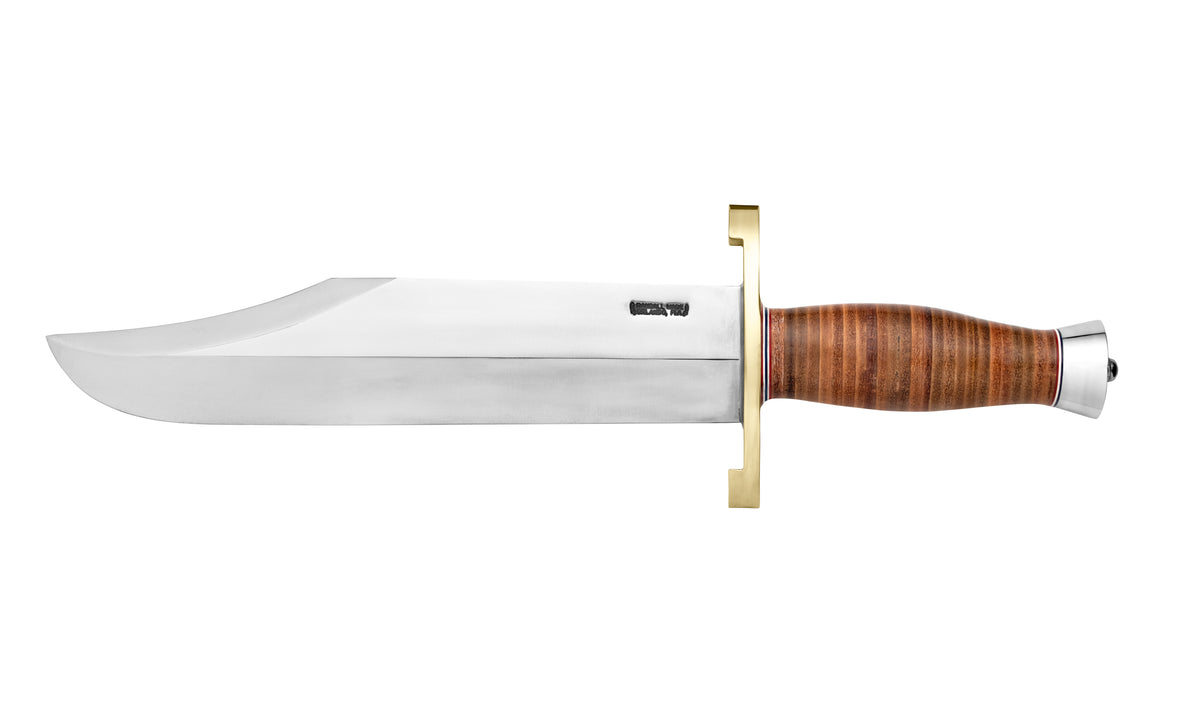
In the early 1950s, Alan Ladd played Jim Bowie in the film *The Iron Mistress*. According to Randall’s own account, following the film’s success, they began producing Bowie knives in 1953. The large Model 12 Smithsonian Bowie is also associated with this workshop. Here, the Bowie knife once again became a blade on which it is worth looking for the maker’s signature. The story of Randall · Randall Model 12
PUMA Original Bowie – Solingen’s own response
According to PUMA, this same trend has also sparked renewed interest in Europe. The Solingen-based makers drew on their own world of hunting knives to interpret the American design. The Original Bowie features an asymmetrical, boat-shaped handle, riveted antler panels and a single-sided guard. It is a good example of how a few different design choices can give the same knife shape a completely different character. PUMA Solingen

Western W49 – large blade from Boulder
The W49 was already featured in Western’s 1968 catalogue from Colorado. It has a blade measuring nearly 24 centimetres, a curved brass crossguard and, on early examples, a rosewood handle. An interesting detail is that early pieces still bore the inscription BOWIE and the Boulder manufacturer’s mark. The model number W49 was only added to the knife itself at a later date. Oregon Knife Collectors Association
Cold Steel – Trail Master and Laredo Bowie
By early 1988, Cold Steel was already marketing the Trail Master as a new Bowie knife. Based on Lynn C. Thompson’s design, the large blade was retained, whilst the buyer could choose a rubberised handle – replacing the wood or antler found on the standard version. The model was produced in several steel grades; the manufacturer still lists a CPM 3V version today. The Laredo Bowie is the brand’s other flagship model. The polished brass crossguard and smooth Micarta handle are closer in appearance to classic Bowie knives. Contemporary Cold Steel advert · Trail Master · Laredo Bowie
Gil Hibben and United Cutlery – back on the silver screen
In 1988, the Bowie knife took centre stage in Hollywood once again. The distinctive knife featured in *Rambo III* was crafted by Gil Hibben for the film, and United Cutlery went on to release production models based on the knife-maker’s designs. By this point, the Bowie’s form had become so instantly recognisable that even just the silhouette of the knife from the film remained etched in people’s minds. United Cutlery · AFI Catalogue

Muela – a Bowie knife from a Spanish hunting knife workshop
In the mid-1950s, Eladio Muela León aroused interest at his workplace, a Spanish refinery, with a pocket knife he had made himself. This marked the beginning of what would later become Manufacturas Muela. The BW-24 range is on a completely different scale. It features a long blade and a prominent crossguard, and the catalogue also lists versions with moulded wood and antler handles. It makes for an interesting counterpart to the PUMA. Two European hunting knife workshops, the same American inspiration, two distinctly different knives. The history of Muela · Muela BW-24
Fällkniven Modern Bowie – the Swedish take on it
Fällkniven was founded in Sweden in 1984. The MB, or Modern Bowie, appeared in the catalogue alongside the manufacturer’s professional fixed-blade knives, featuring laminated CoS steel and a black leather sheath. They retained the wide blade and the proportions of the Bowie, whilst adapting the construction to match their own modern knives. This idea also takes us back to the Shaman workshop. Which design philosophy does one stick to, and where does the knife begin that one crafts specifically for one’s own tasks? The History of Fällkniven · Fällkniven Modern Bowie
This is how I reimagined the Bowie at the Shaman workshop
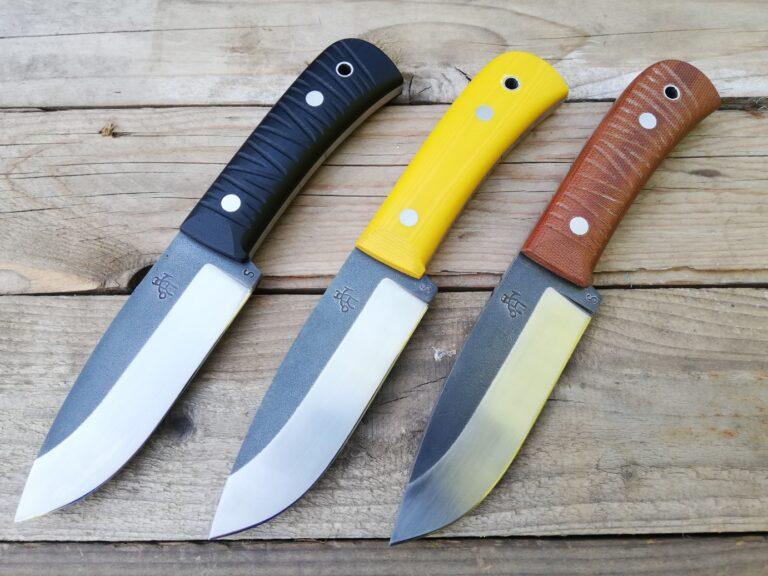
After seeing so many different Bowies, the question naturally arises as to what I would focus on in a Hungarian workshop. I was set on two details: the chiselled tip and the crossguard. My own blade widens towards the tip. At its widest point it is 45 mm; the base material is 8 mm thick Sleipner tool steel, with a hardness of 59–60 HRC. The shape of the blade’s spine, when viewed from the side, gives it a silhouette that I can immediately recognise as a Bowie knife. The straight line tapers into a convex cutting edge, and I polish the blade’s surface by hand.
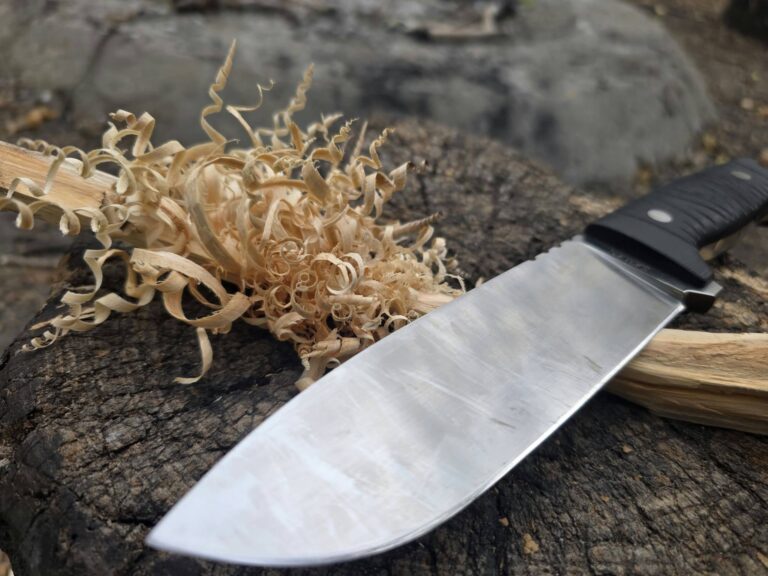
The thickness lends the knife some weight, but I wanted to balance the weight distribution so that it remains manageable in the hand. I intended it for splitting kindling and camp tasks involving thicker branches. If the task involved longer, fiddly carving, I’d choose a lighter blade. For me, the Bowie comes into its own where I’d only make slow progress with a smaller knife.
The 135 mm handle is fuller in the centre, with a narrower grip at the front and back. I call this the ‘fish-body’ shape. When you hold it, your fingers rest on the fuller central section, whilst in front of them is the crossguard, formed from a single piece with the blade. The handle can be made, for example, from black FR4, Micarta or wood. For the sheath, you can choose between black cowhide or brown buffalo hide. Technical specifications of the Shaman Bowie
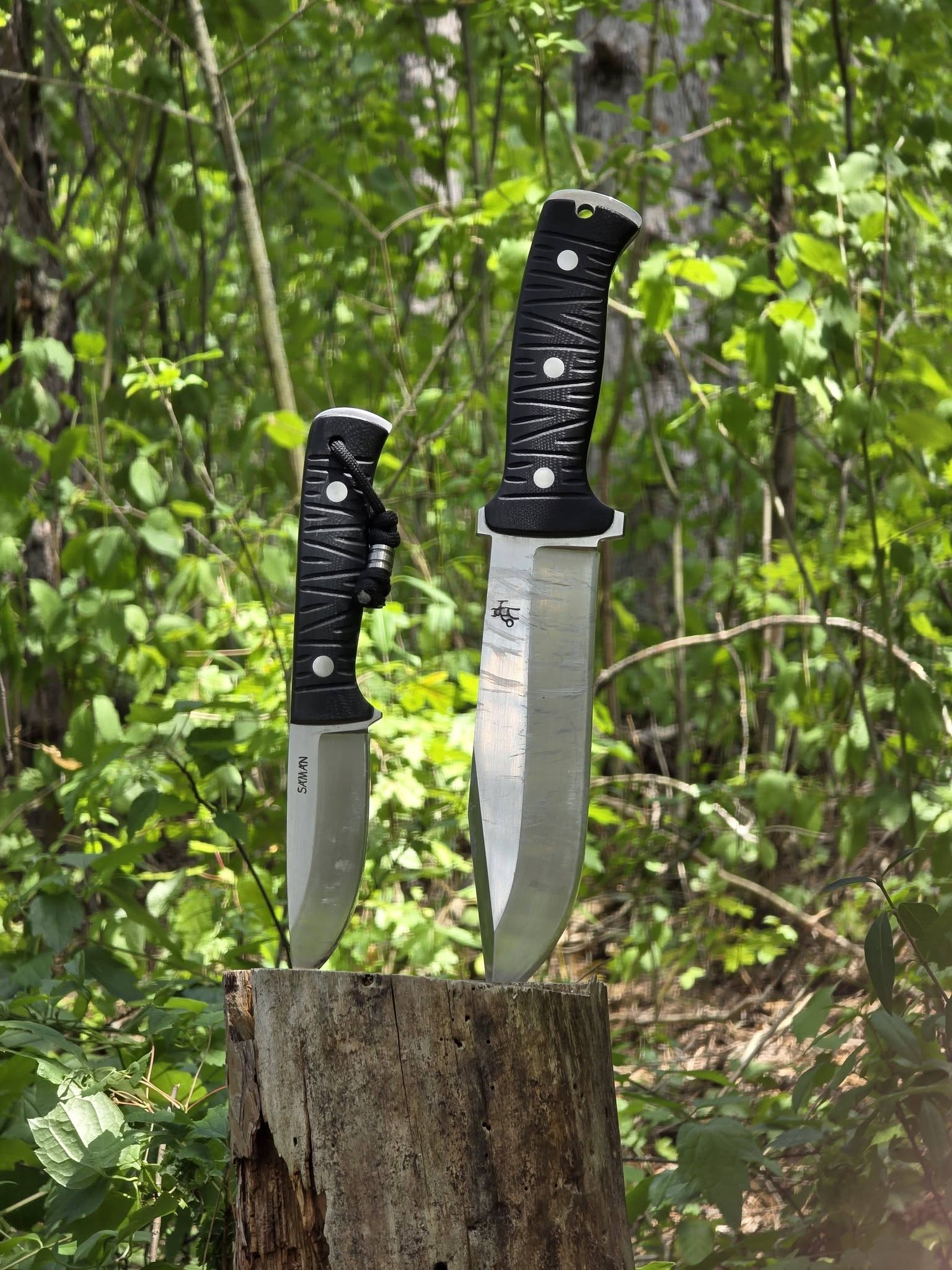
If you’re looking for a large camping knife like this, take a look at the photos and the available designs. If you have any ideas about the handle or the sheath, let us know and we’ll discuss them.
Oh, and most importantly: this knife is entirely handmade!