Contents
- Which knife should I choose from the Shaman workshop?
- 1. What tasks are you looking for a knife for?
- 2. How long should the blade be?
- 3. Which steel and edge profile should you choose?
- 4. Which Shaman bushcraft knife should you choose?
- 5. Quick comparison
- 6. Three tips before buying a knife
- Summary – which one do I recommend?
Which knife should I choose from the Shaman workshop?
This is a frequently asked question from first-time buyers or less experienced knife enthusiasts.
In my view, a good bushcraft knife isn’t defined by being as big, thick or expensive as possible. It’s good because it allows you to carry out the task you took it into the woods for.
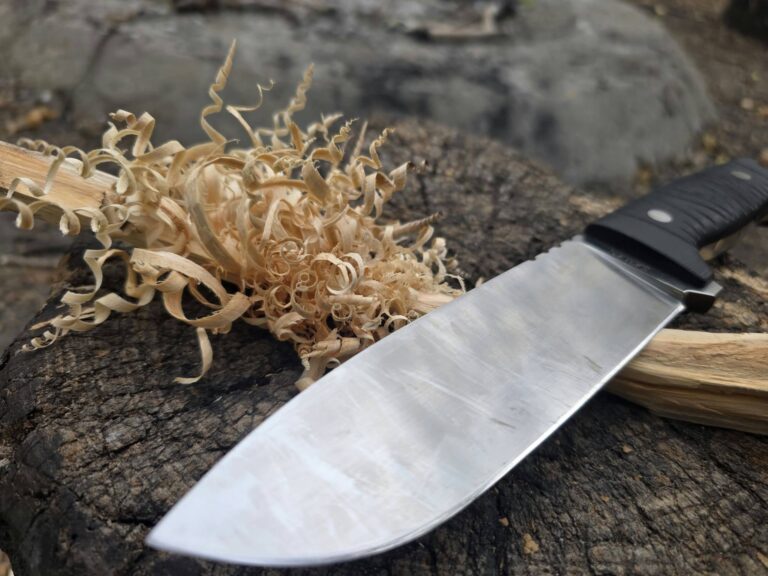
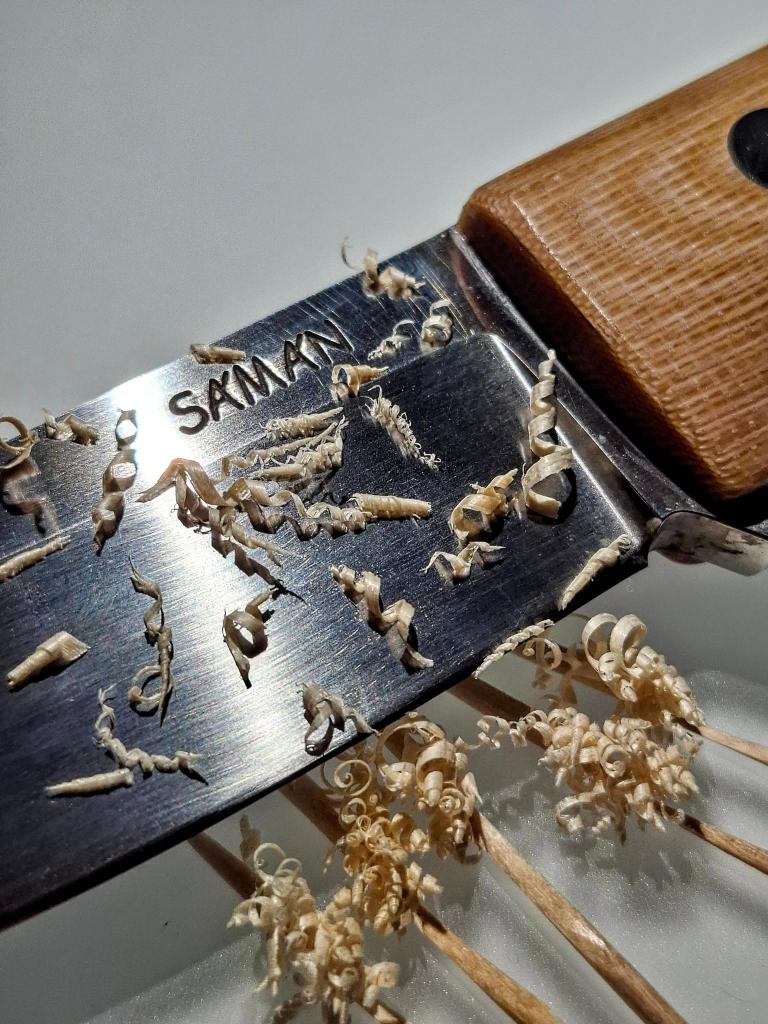
When I design a knife, I think of it first and foremost as a tool. A tool with which you can carve wood, prepare a fire, make simple camping equipment, and which you can rely on even during a stay in the woods lasting several days.
There is no such thing as a perfect knife that is equally suited to every task. I’ll show you what criteria to consider when choosing a knife, and which of my own models I recommend for which uses.
1. What tasks are you looking for a knife for?
I’d always start by considering the intended use.
Hiking and light use in the woods: portability, a comfortable grip and a blade that’s easy to control are important. You don’t need a huge knife for whittling, food preparation and smaller tasks.
Traditional bushcraft: if you regularly carve, make quill-tipped sticks, sharpen stakes or craft small wooden tools, blade geometry and ergonomics are particularly important.
Heavier camp work: if you frequently split smaller pieces of wood or carry out rougher woodworking, a more robust blade may be advantageous. In return, you’ll get a heavier weight and less refined cutting performance.
These tasks naturally overlap. The key is to consider which one you do most often.
2. How long should the blade be?
International bushcraft guidelines often recommend a blade length of 9–12 cm for general use. I broadly agree with this: a 10–11 cm knife can handle the vast majority of tasks in the woods.
The thickness is a more interesting question.
Many traditional bushcraft knives are made with blades around 3–4 mm thick. In several of my models, I deliberately use 5–6 mm thick blade stock.
Why?
Because I like strong, solid working knives. This is one of the defining characteristics of Shaman Workshop.
A thicker blade can be an advantage for certain heavier tasks, but for fine slicing and carving, a thinner blade can handle the work more easily. I don’t want to gloss over this.
If you’re primarily looking for a knife for precise carving, my thickest blade might not be the best choice.
3. Which steel and edge profile should you choose?
There isn’t a perfect knife steel for every task. You always have to strike a balance between edge retention, toughness, corrosion resistance and sharpenability.
Sleipner: I use this in several of my models. It is a wear-resistant tool steel which, with the right heat treatment, makes an excellent base material for working knives. It is not stainless, so it requires maintenance.
Böhler N690: a stainless knife steel which I primarily recommend for those who frequently use their knives in damp environments.
Rigor: also a tool steel; it can be a good alternative for a general-purpose utility knife, but protection against corrosion is even more important here.
The edge design is at least as important.
The Scandinavian-style edge design glides smoothly over the surface of the wood, which is why it is popular for woodcarving. For many of my knives, I work with a straight back edge and a narrow, convex cutting edge. In doing so, I seek a balance between good cutting performance and adequate edge retention.
The name of the steel alone is no guarantee of anything. It is the combination of heat treatment, blade geometry and handle design that makes a knife a good tool.
4. Which Shaman bushcraft knife should you choose?
I’ve designed my own models for different tasks. I’m not claiming that each one is equally suitable for everything.
Scandi – for woodcarving enthusiasts
100 mm blade · 4 mm thickness · Sleipner
I drew inspiration from the world of Nordic puukko knives. Within my range, this is an easier-to-handle, carving-focused model.
I recommend it for finer woodwork, making feathered branches and general woodland tasks.
I’d choose this one if precise blade work is more important than a higher load capacity.
Nomad – the versatile hiking companion
105 mm blade · 5 mm thick version · N690 or Rigor
I’d recommend the Nomad to anyone looking for a versatile knife that’s easy to carry. It’s a good choice for carving, food preparation and smaller tasks around camp.
The N690 version is particularly worth considering if corrosion resistance is a priority.
I’d recommend this first and foremost to anyone who goes hiking a lot and wants a single, all-purpose utility knife.
Bushcrafter 11 – the powerful all-rounder
110 mm blade · 6 mm thickness · Sleipner
This model is a good representation of my own approach to knife-making. It is a short but sturdy, powerful utility knife.
I recommend it for rougher carving, making stakes, working with smaller pieces of timber and general camp tasks.
Due to the thicker blade, it may require more force for finer cutting tasks.
This is the one I’d choose if I needed a compact yet truly robust bushcraft knife.
Medium Trapper – traditional shape, modern design
110 mm blade · 6 mm thickness · Sleipner
Inspired by the design of old North American work knives. It features a wider blade and a distinctive handle.
I recommend it for woodworking, general bushcraft activities and camp tasks.
I’d choose this if I were looking for the character of historic work knives, but made with modern materials.
Heavy-Duty Bushcrafter – for heavier tasks
140 mm blade · 6 mm thickness · Sleipner
The HDB is one of my knives designed for heavier use. Due to its longer and wider blade, I recommend it primarily for rougher camping tasks.
It may be better suited to splitting smaller pieces of wood and more vigorous woodworking than the smaller models.
However, I wouldn’t recommend it to anyone looking for a knife exclusively for fine carving or light hiking.
The HDB is for those who know they need a larger blade.
View the Heavy-Duty Bushcrafter
5. Quick comparison
| Model | Blade length | Thickness | Primary use |
|---|---|---|---|
| Scandi | 100 mm | 4 mm | Fine carving |
| Nomad | 105 mm | 5 mm* | Hiking, general use |
| Bushcrafter 11 | 110 mm | 6 mm | Robust bushcraft |
| Medium Trapper | 110 mm | 6 mm | Traditional forestry work |
| HDB | 140 mm | 6 mm | Heavier field work |
The Nomad may also be available in different blade configurations; please always refer to the current product description.
6. Three tips before buying a knife
Don’t look for the biggest knife. A larger blade isn’t necessarily better. The right size always depends on the tasks at hand.
Don’t just look at the name of the steel. A good knife also needs proper heat treatment, blade geometry and a comfortable handle.
Don’t try to do everything with a knife. For working with larger pieces of wood, a saw or axe is often more suitable. Part of bushcraft is knowing which tool is best for which job.
Summary – which one do I recommend?
If you’re looking for a knife for finer carving, go for the Scandi.
If you want a versatile hiking knife, I recommend the Nomad.
If you need a sturdy, general-purpose bushcraft knife, take a look at the Bushcrafter 11.
If you prefer the design of traditional forest knives, the Medium Trapper might be the knife for you.
And if you’re looking for a tool for heavier camp work, I’d recommend the Heavy-Duty Bushcrafter.
I don’t want to sell you my most expensive or largest knife, but the one you’ll actually use.
If you’re unsure, get in touch. Tell me what you’d like to use your knife for, and I’ll help you find the right model.
Check out the Shaman bushcraft knives
See you in the woods!
László Német – Shaman