
Contents
Many people ask me what the difference is between a bushcraft knife and a camping knife. Where does the line lie, and which one should you choose?
The answer is simpler than you might think: it’s not the name of the knife that matters, but the task for which it was designed.
There is no clear-cut distinction between the two categories. A good bushcraft knife can handle a wide range of camping tasks, and a larger camping knife may also be suitable for carving. The difference lies primarily in the size, the blade design, the weight and the resulting usability.
What is a bushcraft knife?
Bushcraft refers to the body of practical knowledge and craft activities that can be used in the wild. This includes, for example, starting a fire, building a shelter, making simple tools or preparing food.
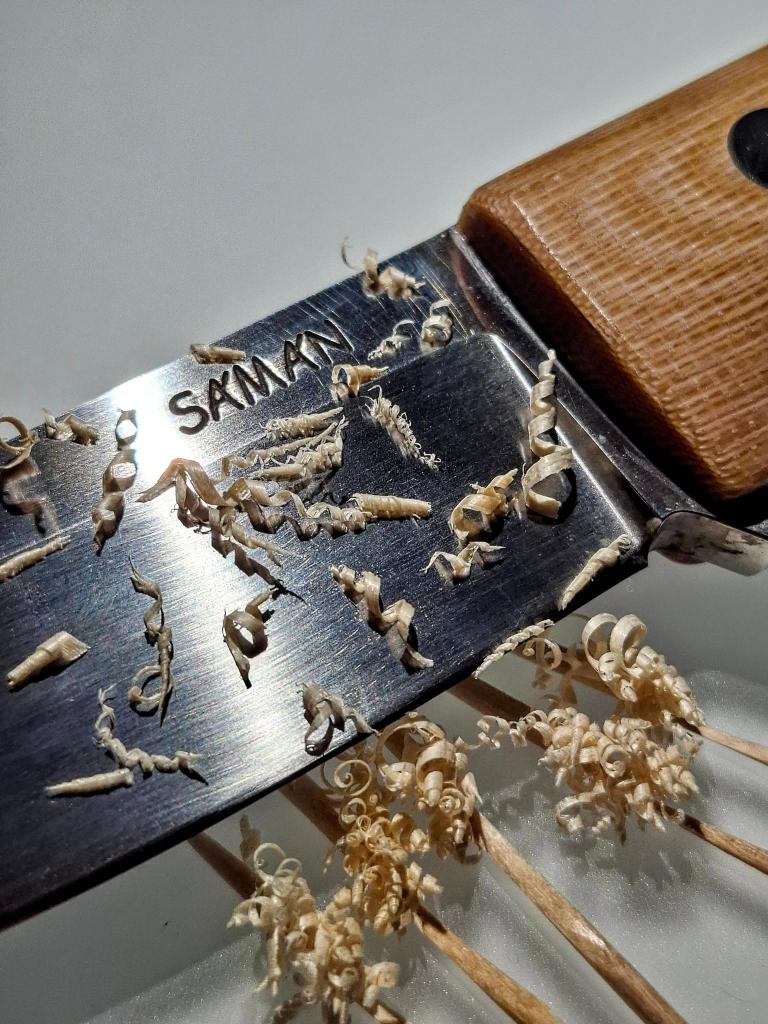
For these tasks, you primarily need a comfortable, easy-to-control utility knife that allows you to work precisely for extended periods.
The blades of classic bushcraft knives have a typical length of 9–12 cm. This size offers a good balance between portability and usability.
From my own range, I would highlight three models:
- Scandi: with a 10 cm long, 4 mm thick blade. I recommend this primarily for carving and finer woodwork.
- Nomad: With a 10.5 cm blade, this is an easily portable, versatile forest work knife. It is a good choice for hiking and general bushcraft use.
- Bushcrafter 11: with an 11 cm, 6 mm thick blade. A more robustly designed knife for those who wish to tackle more strenuous tasks alongside finer work.
As you can see, there are already significant differences within this category. The Scandi and the Bushcrafter 11 are work knives of similar length, yet with different characteristics.
What makes a knife a camping knife?
A camping knife is a broader concept. When setting up and maintaining a forest camp, tasks requiring greater physical effort occur alongside finer carving work.
These might include chopping, limbing or splitting smaller pieces of timber, or preparing materials needed for a shelter.
For these tasks, a longer, heavier blade can be an advantage. The momentum of a larger knife can be utilised more effectively for striking cuts.
That is why you will find blades ranging from 12 to 22 cm in length amongst my own camping models.
A few examples:
Bushcrafter 12 – This model bridges the gap between bushcraft and camping knives. The 12 cm long, 6 mm thick blade results in a compact yet powerful utility knife.
Adventurer – With its 18 cm blade, this is a more serious camping tool. I recommend it primarily for multi-day hikes, shelter-building and heavier woodworking.
Leuku – My own version of the traditional work knife of the Sámi people. The 22 cm blade shows its advantages when whittling, chopping and for larger camp tasks.
However, a knife of this size isn’t automatically better for every task. For fine carving or food preparation, a smaller, thinner blade is often more convenient.
Is a thicker blade always better?
One of the hallmarks of Shaman knives is their robust design. Most of my models are made with a 6 mm thick blade with a spine.
This is a deliberate design choice, but it does not mean that such thick steel is required for every job.
A thinner blade generally slices more easily and can be guided more precisely through the material. A thicker blade can provide greater rigidity and may be preferable for certain more demanding tasks.
The thickness of the blade alone does not make a knife better. The steel, heat treatment, edge geometry and handle are just as important.
That is precisely why I make models with different characteristics. I don’t want to sell the same knife to everyone.
Can a camping knife replace an axe?
For certain tasks, yes, but not in every case.
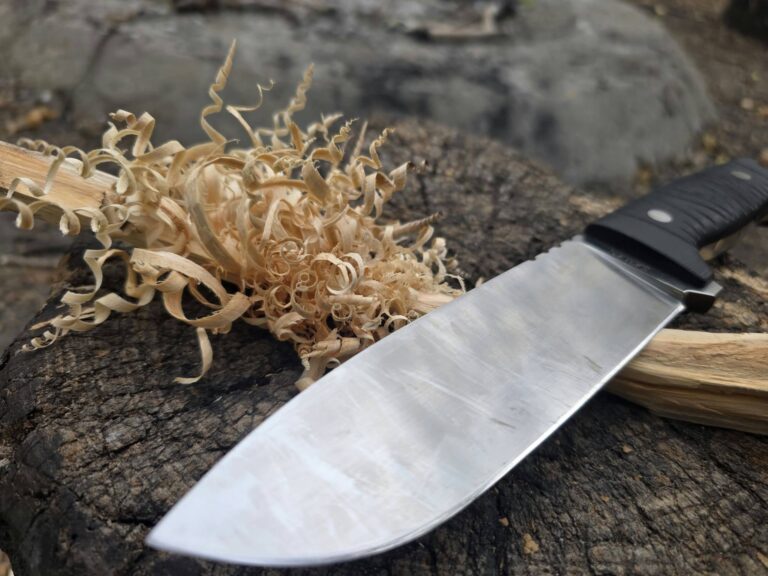
A larger camping knife may be suitable for cutting thinner branches, working with smaller pieces of timber and rough carving. A well-designed Leuku or Adventurer may already have sufficient weight for these tasks.
When working with larger logs, however, a good axe or saw may be a more efficient and safer choice.
I regard the knife primarily as a working tool, not as a device with which one must solve every problem at all costs.
Which knife should you choose?
| Intended use | My recommendations |
|---|---|
| Fine carving, making small wooden tools | Scandi |
| Hiking, general forest tasks | Nomad |
| Robust, versatile bushcraft use | Bushcrafter 11 |
| Bushcraft and basic camp tasks | Bushcrafter 12 |
| Multi-day camping, more intensive woodworking | Adventurer |
| Pruning, chopping, larger camp tasks | Leuku |
The table does not imply that individual knives can only be used for these specific tasks. It shows where the design advantages of each model can best be utilised.
Do you need both?
Not necessarily.
If you’re mainly out hiking, occasionally do some woodcarving, build fires and carry out minor tasks around camp, a good bushcraft knife on its own may be sufficient.
However, if you regularly spend longer periods in the woods, build shelters and work with larger quantities of timber, it may be worth choosing a larger camping knife, or taking a suitable saw or axe alongside the smaller knife.
Many people opt for two knives: a smaller one suitable for precision work and a larger, more robust tool. This is a viable solution, but it isn’t necessary for everyone.
My advice is to always choose a knife based on your most common task, not the rarest or most difficult one.
If you mainly do carving, you may not need a huge camping knife. If, on the other hand, you regularly work with tougher types of wood, a small carving knife on its own might not be enough.
At Shaman Workshop, I make models for both types of use. If you’re unsure, just tell me what you’d like to use your knife for, and I’ll help you find the right design.
See you in the woods!